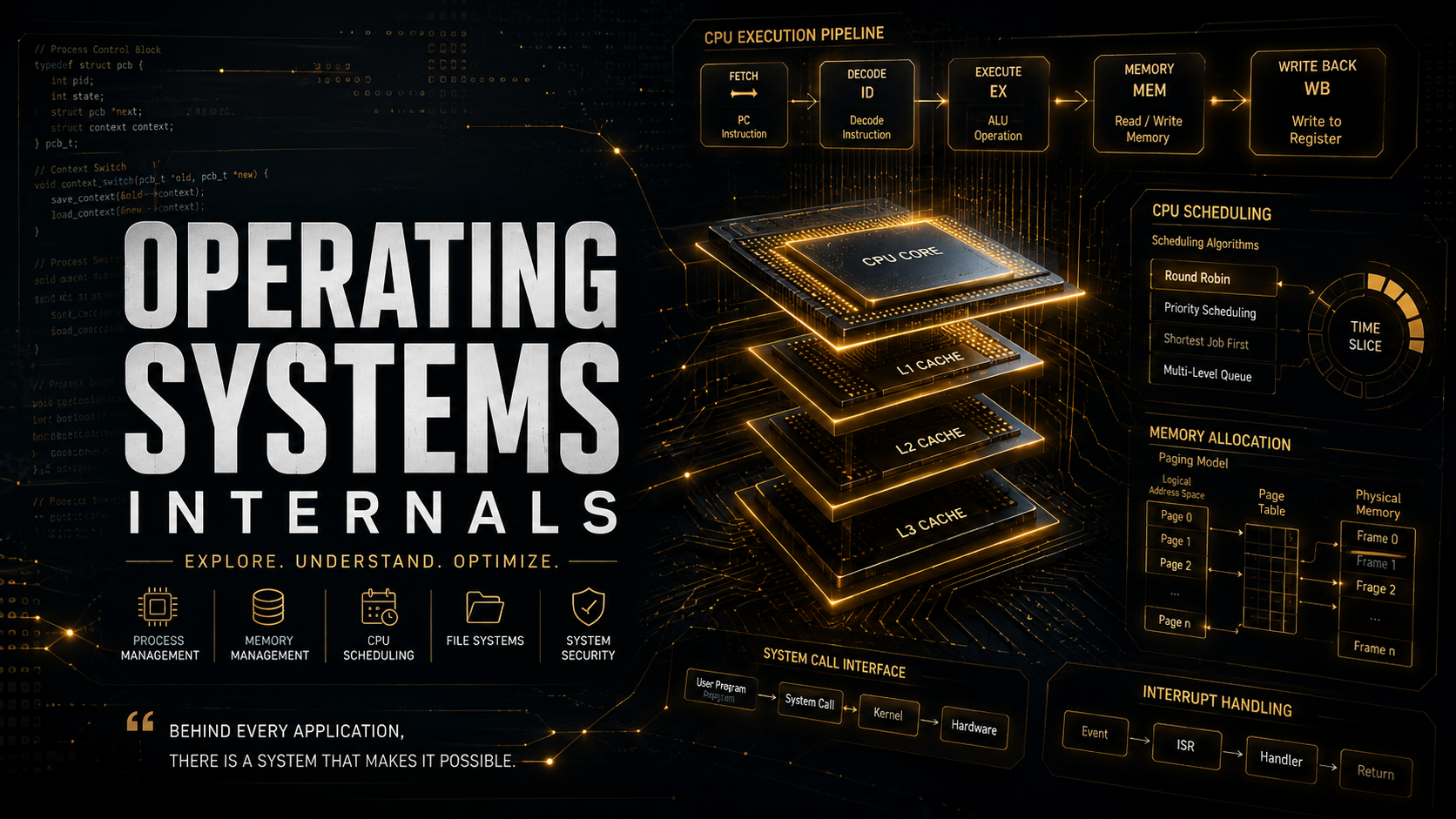
Operating Systems Concepts & Architectural Internals

Operating Systems Concepts & Architectural Internals

Core Foundations Enrolled Students: 98 4.5 (30 Reviews)

Course Overview

Decode the deep mechanical layers, memory allocation channels, and process scheduling engines that drive modern computing perimeters. This core science module is custom-engineered to unlock internal operating patterns.

### COURSE OVERVIEW
Every high-end application development pass or security audit operation relies fundamentally on underlying operating systems resources management architectures. This module shifts focus from typical superficial software usage to executing deep analytical checks across CPU registers structures, thread synchronization parameters, paging files layout, and hardware interface abstractions. Trainees inspect system internals to observe how software kernels handle concurrent executions safely.

### WHAT YOU'LL LEARN:
* Dissect system call interfaces and analyze how application software blocks interact with underlying operating system kernels.
* Evaluate CPU process scheduling algorithms including shortest job first metrics and dynamic round robin execution models.
* Resolve concurrent execution barriers by programming clean thread synchronization matrices, mutex locks, and semaphores.
* Analyze virtual memory paging mechanics, translation lookaside buffers (TLB), and cache replacement algorithm metrics.
* Trace filesystem storage allocation tables, distributed block management configurations, and deadlock recovery architectures.
* Understand hardware abstraction layers (HAL parameters) and observe how device drivers initialize communication with system bridges.
* Construct robust optimization metrics to evaluate system latency parameters during dense multi-threaded server operation pipelines.

Course Curriculum

Detailed module-wise learning path for this course:

  • Understanding Hardware Abstraction Layers (HAL) & System Call Kernel Interaction Interfaces
  • Evaluating CPU Scheduling Metrics: First-Come-First-Served, Shortest Job First, and Round Robin Arrays
  • Process Management Architecture: Thread Lifecycles, Context Switching Overhead, and Child Clones
  • Resolving Concurrency Blocks via Mutex Locks, Counting Semaphores, and Shared Memory Boundaries

  • Analyzing Physical Memory Segmentation, Contiguous Storage Allocations, and Internal Fragments
  • Virtual Memory Architectures: Paging File Systems Layout, Frame Allocations, and Page Fault Diagnostics
  • Translation Lookaside Buffer (TLB) Hardware Cache Acceleration & Page Address Conversion Mappings
  • Evaluating High-Performance Cache Replacement Algorithms (Least Recently Used, Optimal, FIFO Metrics)

  • Dissecting Disk Filesystem Layouts: Allocation Methods (Contiguous, Linked, Indexed Nodes Systems)
  • Directory Structure Implementations, Dynamic Storage Partitioning Rules, and File Protection Flags
  • Analyzing System Deadlocks Prerequisites and Constructing Resource Allocation Mapping Graphs
  • Implementing Banker's Algorithm for Deadlock Avoidance, Detection Routines, and Safe State Vetting

  • Tracing Hardware Input/Output Subsystem Infrastructures & Interrupt Service Routines (ISR Matrices)
  • Kernel-Level Synchronization Primitives, Device Controller Registries Mapping, and Direct Memory Access (DMA)
  • Analyzing Storage Architecture Scheduling: SCAN, C-SCAN, and Shortest Seek Time First (SSTF) Protocols
  • Security Isolation Layers Internals: Monolithic vs Microkernel Architectures & Memory Ring Protection Models

Frequently Asked Questions

Find answers to common questions about this course:

Understanding kernel interactions, memory rings protection models, and system call paradigms gives you a deep structural grip to analyze how programs execute and how malware attempts memory allocation vulnerabilities.

You will evaluate CPU process scheduling algorithm metrics like shortest job first and round robin, and resolve execution blocks by programming thread synchronization matrices, mutex locks, and semaphores.

The program covers virtual memory mapping systems, translation lookaside buffers (TLB) hardware cache acceleration, page fault indicators diagnostics, and high-performance page replacement mechanics like Least Recently Used (LRU).

Yes. You will dissect disk filesystem layout methods (linked, indexed nodes systems) and simulate resource allocation mapping graphs using Banker's algorithm for safe state vetting and deadlock avoidance.

Absolutely. Trainees observe performance boundaries between Monolithic and Microkernel models, study hardware abstraction layers (HAL), and trace how device controllers communicate via Interrupt Service Routines (ISR matrices).

Student Testimonials

Sandeep Soni

"Masterpiece performance metrics track for core system backend developers who need deep architecture internals monitoring skills."

Monika Rao

"Memory management parameters sorting schemas allowed swift thread resource allocation optimization maps inside systems loops."

Abhishek Agrawal

"Kian technologies provides the most exhaustive system internals structural exploration maps across central training zones."

Komal Shukla

"Paging algorithms simulation data streams require steady computational calculations focus par code structures are clear."

Nitin Dewangan

"High efficiency scheduling simulations parameters are robust. Fully satisfied with deep technical architecture segmentation parameters."

Registration Fee
₹999/-
Course Fee: ₹9,999/-
Duration: 8 - 12 Months
Instructor: Kian Sir
Mode: Online / Offline
Labs: Flexible / Live Labs
Certificate: Yes (Verified)
Request Brochure Enquire Now