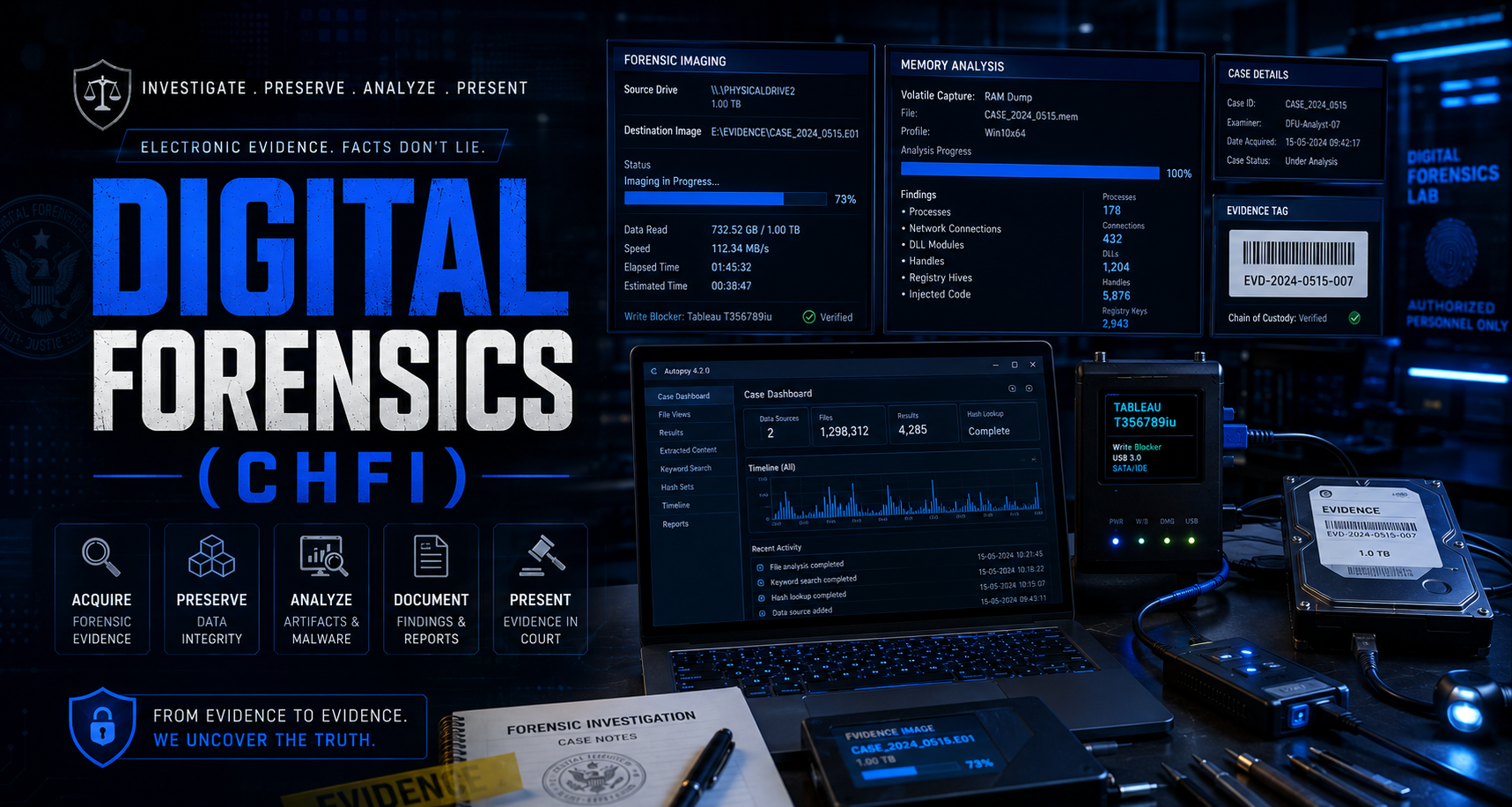
Welcome to the official flagship blueprints of the EC-Council CHFI framework, meticulously engineered to master the dark mechanics of digital forensics, electronic evidence tracking, and threat incident remediation pipelines.
### COURSE OVERVIEW
When modern corporate perimeters encounter highly advanced cyber breaches or insider threat indicators, raw automated monitoring tools alone fail to track the systemic footprint of the adversary. This program provides deep technical immersion into corporate hard-drive imaging, volatile RAM structure analysis, network traffic packet reconstruction, cloud infrastructure log tracking, and legal evidence documentation guidelines. Under direct senior practitioner monitoring, you will learn to execute deep forensic investigations that align perfectly with international regulatory court-admissible matrices.
### WHAT YOU'LL LEARN:
* Implement robust physical and logical hard-drive imaging workflows safeguarding evidence integrity utilizing write-blocker configurations.
* Dissect system volatile artifacts registries, master deep RAM extractions patterns, and trace running malicious process structures flags.
* Parse file system metadata internals across NTFS, FAT32, exFAT, and EXT4 tracking deleted cluster remnants and alternate data streams (ADS).
* Reconstruct complex security incident data packets and web communication logs manually to trace data breach sources indicators.
* Conduct anti-forensics tracking maneuvers by identifying hidden partitions variables, metadata stripping anomalies, and steganographic data streams.
* Analyze advanced endpoint operating logs and server event registries across Windows, Linux, and corporate cloud infrastructure systems.
* Compile court-ready digital forensic investigation reports specifying technical parameters and tracking timeline logs flawlessly.
### COURSE REQUIREMENTS:
* Comprehensive familiarity with terminal terminal command layouts and standard computational storage pathways navigation.
* Preliminary clarity regarding network communication models (Mastery over general CEH ethical hacking baselines is highly recommended).
* Technical workstation configuration running a minimum of 8GB to 16GB RAM to support nested forensic laboratory storage units smoothly.
### WHO THIS COURSE IS FOR:
* Cyber Defense Professionals and Incident Responders needing an elite investigative grip to isolate advanced data breach tracks globally.
* Security Consultants, Corporate Fraud Investigators, and Law Enforcement Officials seeking to validate forensics credentials under EC-Council paradigms.
Course Curriculum
Detailed module-wise learning path for this course:
Module 01: Computer Forensics in Today's World & Legal Regulatory Frameworks
Module 02: Computer Forensics Investigation Process Standards & Standard Operating Procedures (SOPs)
Module 09: Web Server Forensics & Analyzing Enterprise Logs Records (IIS Log Patterns, Apache Access Indicators)
Module 10: Database Forensics: Auditing MS SQL Server, Oracle, and MySQL Event Traversal Parameters for Breaches
Module 11: Cloud Forensics Processes: Architecture Auditing across AWS CloudTrail Logs and Azure Active Directories
Module 12: Malware Forensics Processes: Setting Isolated Laboratory Sandboxes for Static and Dynamic Executions Analytics
Investigating Malicious Registry Injection Changes, Persistent Backdoors Hooks, and System Log Clearing Artifacts
Virtualization Environment Verification Loops: Extracting Artifacts out of Live Hyper-V and VMware VMDK Storage Frameworks
Module 13: Mobile Forensics Processes: Tracking Extracted Android and iOS App Storage Topologies and DB Records
Module 14: IoT Forensics & Module 15: Email Forensics: Tracking Malicious Email Headers, Phishing Routes, and Source IP Blocks
Module 16: Investigative Report Writing Guidelines: Formatting Professional Technical Case Files for Law Enforcement
Assembling Technical Evidence Vectors smoothly aligned with Global CVSS Parameters and Legal Presentation Metrics
Frequently Asked Questions
Find answers to common questions about this course:
Yes, 100%. The training roadmap is systematically structured around the official EC-Council computer hacking forensic investigator curriculum, comprehensively covering physical storage duplication, registry analysis, database metrics parsing, and cloud ecosystem auditing tracks.
Trainees achieve extensive hands-on command over professional tools including the Volatility Memory Dump Analyzer, EnCase data formats tracking, FTK Imager systems, Autopsy Forensics suites, Wireshark packet analyzers, and custom automated log scraping scripts.
While not a mandatory barrier, having a structural baseline understanding of system exploitation loops, web application faults, and general scanning commands helps you execute root cause analysis significantly faster during tracking labs.
Absolutely. A major module targets physical signature-based data carving out of cluster slack spaces and unallocated hard drive sectors, allowing candidates to safely extract deleted file types even when system tables are completely scrubbed.
Validating this track opens high-paying core corporate profiles including Digital Forensics Analyst, Incident Response (IR) Engineer, Information Security Auditor, and Cyber Security Consultant across enterprise threat landscape management networks.
Student Testimonials
Juhi Soni
"High performance automated log processing code systems are satisfying. Complete customer satisfaction across all specialized sessions."
Amitesh Nishad
"Target payload exfiltration tracing frameworks built massive confidence during forensic data mining trials. Labs are top level."
Monika Sahu
"Volatile parameters extraction algorithms tracking templates are designed modernly. Best choice for serious information tracking analysts."
Abhishek Dewangan
"Every section features real world incident tracking guidelines tracking. Best dynamic decision to upgrade portfolio metrics profiles."
Komal Rao
"Chain of custody verification protocols validation pipelines are robust. Explanations loops match corporate standards completely."