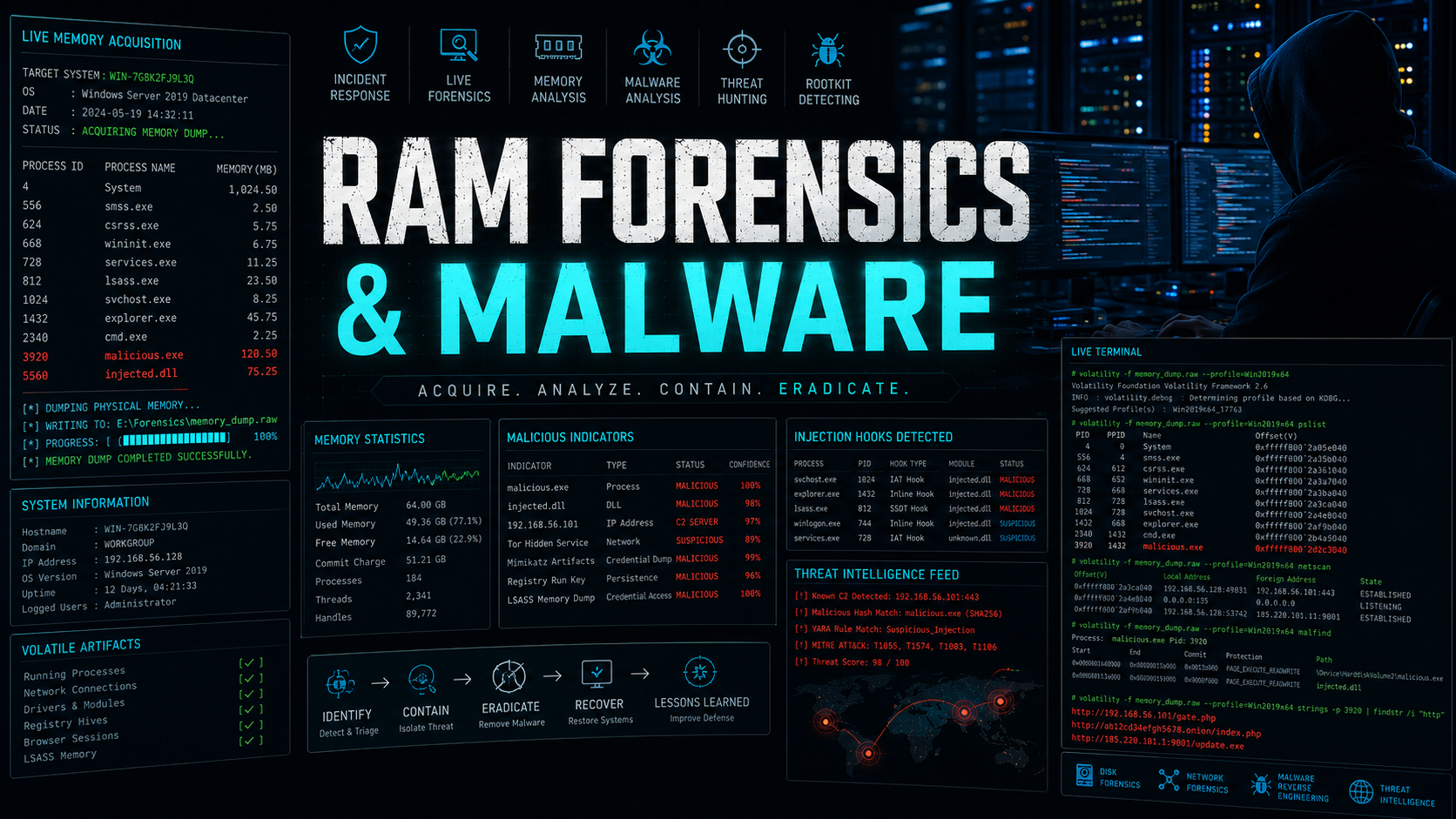
Dive deep into live incident response parameters, extracting unallocated volatile memory dumps, and tracking high-severity active process injection footprints before system shutdowns.
### COURSE OVERVIEW
When modern systems encounter volatile software threats or zero-day script breaches, critical operational markers exist solely inside physical processing memory layers. This course switches from typical file scanning protocols to running manual RAM dumps extraction and memory buffer analytics under direct expert guidance. You will learn to isolate stealth system execution paths and trace active command injection remnants inside affected architectures seamlessly.
### WHAT YOU'LL LEARN:
* Capture stable memory data logs from live running systems safely utilizing non-intrusive command line utilities.
* Parse volatile memory dumps leveraging structural Volatility framework analytics engines.
* Reconstruct multi-tier running process execution hierarchies and inspect system sockets records.
* Audit running operating parameters to locate stealth kernel privilege modifications and active DLL system hooks variables.
* Analyze volatile system registries data pools and extract historical account navigation metrics out of User shellbags structures.
* Track malicious runtime patterns by correlating hidden Prefetch file sequences and dynamic Shimcache logs.
### COURSE REQUIREMENTS:
* Operational familiarity with terminal command lines (Basic cmd operations or basic Linux terminal exposure).
* Computational workspace platform running a minimum of 8GB RAM to support virtualization testing loops safely.
### WHO THIS COURSE IS FOR:
* Incident Responders and Security Analysts focused on tracking live system threat actions and analyzing system memory state anomalies.
Detailed module-wise learning path for this course:
Find answers to common questions about this course:
"Active socket connections aur running thread components tracking are perfectly covered. Best specialized track for response teams."
"Bhilai technical belt me memory forensic aur volatile artifacts monitoring sikhane wala isse standard module nahi h. Fully worth it."
"Shellbags entries aur prefetch log tables parse krne ka assignment was pure gold. Local system logs analysis limits are top standard."
"Volatility command line parameters seekhne ke baad memory structure clear ho gya. Hidden DLL system hooks ko easily trace kiya."
"Live running machine se WinPmem use krke crash dump nikalna aur volatile process trees analyze krna bohot dynamic practical rha."
|
Registration Fee
₹500/-
|
|
| Course Fee: | ₹5,999/- |
| Duration: | 2 - 3 Months |
| Instructor: | Kian Sir |
| Mode: | Online / Offline |
| Labs: | Flexible / Live Labs |
| Certificate: | Yes (Verified) |