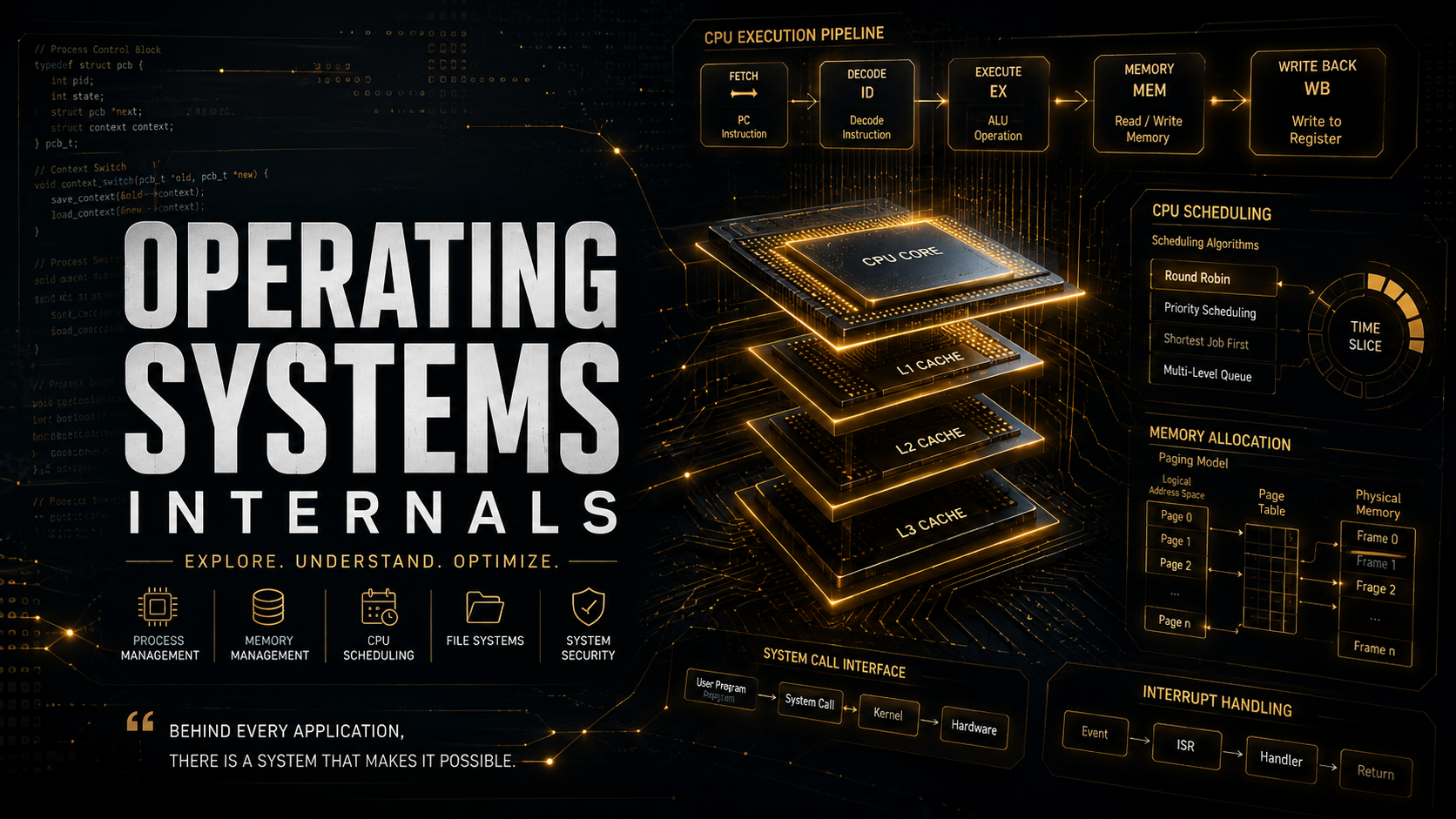
Decode the deep mechanical layers, memory allocation channels, and process scheduling engines that drive modern computing perimeters. This core science module is custom-engineered to unlock internal operating patterns.
### COURSE OVERVIEW
Every high-end application development pass or security audit operation relies fundamentally on underlying operating systems resources management architectures. This module shifts focus from typical superficial software usage to executing deep analytical checks across CPU registers structures, thread synchronization parameters, paging files layout, and hardware interface abstractions. Trainees inspect system internals to observe how software kernels handle concurrent executions safely.
### WHAT YOU'LL LEARN:
* Dissect system call interfaces and analyze how application software blocks interact with underlying operating system kernels.
* Evaluate CPU process scheduling algorithms including shortest job first metrics and dynamic round robin execution models.
* Resolve concurrent execution barriers by programming clean thread synchronization matrices, mutex locks, and semaphores.
* Analyze virtual memory paging mechanics, translation lookaside buffers (TLB), and cache replacement algorithm metrics.
* Trace filesystem storage allocation tables, distributed block management configurations, and deadlock recovery architectures.
* Understand hardware abstraction layers (HAL parameters) and observe how device drivers initialize communication with system bridges.
* Construct robust optimization metrics to evaluate system latency parameters during dense multi-threaded server operation pipelines.
Detailed module-wise learning path for this course:
Find answers to common questions about this course:
"Core software execution pipelines are outstanding. Hardware resource tracking capability grew exceptionally deep."
"Translation lookaside buffer tracking algorithms allowed smooth physical memory localization checks. Exceptional class standard."
"Highly detailed resource scheduling technical templates updates. Absolute choice for system low level operations mastery."
"Resource distribution algorithms optimization scripts was successful. Architectural parameters tracking guidelines are highly immaculate."
"Filesystem design blocks and files hierarchy tracking parameters are mapped logically inside active verification projects."
|
Registration Fee
₹999/-
|
|
| Course Fee: | ₹9,999/- |
| Duration: | 8 - 12 Months |
| Instructor: | Kian Sir |
| Mode: | Online / Offline |
| Labs: | Flexible / Live Labs |
| Certificate: | Yes (Verified) |